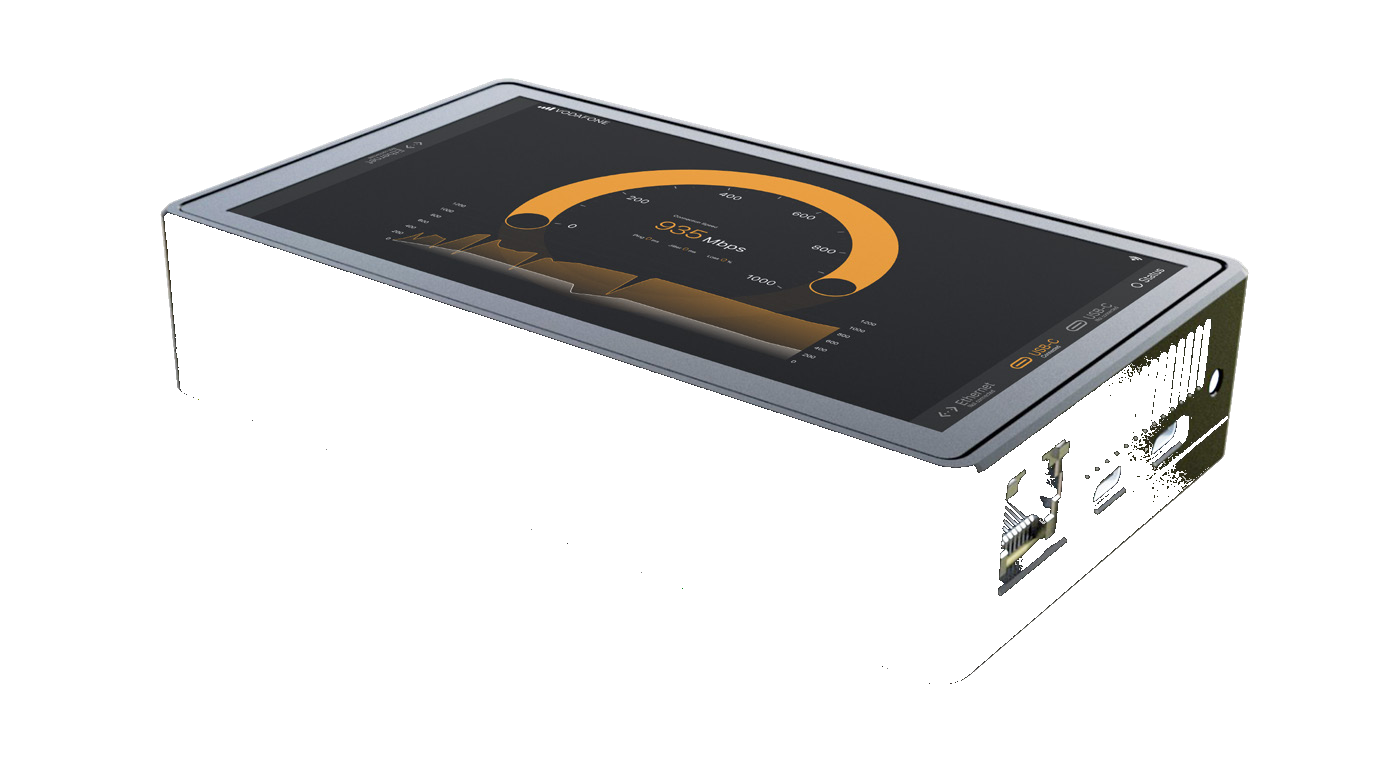
Five principles. Zero compromise. HLS Secure Mesh delivers hardware encryption across a fully decentralized mesh — autonomous nodes, self-healing topology, and built-in resilience that survives node loss, jamming, and targeted attack without human intervention.
HLS Secure Mesh deploys an FPGA-based AES-256 GCM encryption engine on every node — not at the edge, not in software, but at the hardware level on each device in the mesh. When a node goes offline, the network reroutes in milliseconds. No operator required. No central server to attack.
Built on the same cryptographic hardware core as the HLS-HWE1000 — proven in defense and critical infrastructure deployments.
HLS Secure Mesh is engineered around five non-negotiable guarantees — each backed by hardware, not software promises.
Every feature addresses a specific attack surface — hardware bypass, node compromise, topology disruption, or configuration error. Secure Mesh eliminates each one by design.
Nodes broadcast discovery signals, authenticate peers using hardware-bound identities, and negotiate AES-256 GCM sessions automatically. Zero manual configuration — deploy a node, it joins the mesh.
Continuous link-quality monitoring detects failures in sub-second time. Routing tables are recomputed autonomously across remaining peers — no human in the loop, no service interruption visible to applications.
Inter-node tunnels are encrypted by a dedicated FPGA AES-256 GCM engine. Encryption and decryption happen before data reaches the host CPU — even a fully compromised OS cannot read or inject plaintext traffic.
Traditional VPNs and hub-and-spoke networks have a choke point: take out the server, take out the network. Secure Mesh has no such component. Adversaries have no single high-value target to eliminate.
Mesh segments can be physically isolated from all external networks. Bridging between air-gapped segments requires explicit hardware authorization — no accidental exposure, no rogue uplinks.
Mesh routing complexity scales sublinearly. Adding nodes increases redundancy and bandwidth without introducing bottlenecks — capacity grows with the network, not against it.
Software-only solutions rely on the OS being uncompromised — a single exploited vulnerability can expose all traffic. Traditional VPNs collapse when the server goes down. Secure Mesh removes both weaknesses by design: hardware encryption that survives OS compromise, and mesh topology that survives server loss.
| Feature | Traditional VPN | Software Mesh | HLS Secure Mesh |
|---|---|---|---|
| Encryption location | Software (bypassable) | Software | Hardware FPGA (isolated) |
| Central point of failure | Yes (server) | Partial | None |
| Self-healing | No | Limited | Yes — autonomous |
| Hardware tamper protection | No | No | Yes |
| Air-gap capable | No | No | Yes |
| Node discovery | Manual | Automated | Automated |
| Resilience under attack | Low | Medium | High — hardware-enforced |
Any environment where connectivity, encryption, and resilience must be guaranteed simultaneously.
Field units deploy nodes autonomously — no infrastructure required. The mesh routes around jammed frequencies, destroyed relay points, and captured hardware. A compromised node cannot decrypt retroactive traffic; key material never leaves hardware.
OT and SCADA systems interconnected across sites with hardware-encrypted links. No software layer exposes control traffic to interception. Network segmentation is hardware-enforced — a breach in one segment cannot propagate.
Natural disasters, cyber attacks, and infrastructure outages destroy conventional networks. Secure Mesh nodes operate on local power, reform topology around outages, and keep command channels encrypted and operational when centralized systems are down.
HLS Secure Mesh is in active development. Register your interest and our team will reach out as soon as it's available for evaluation.